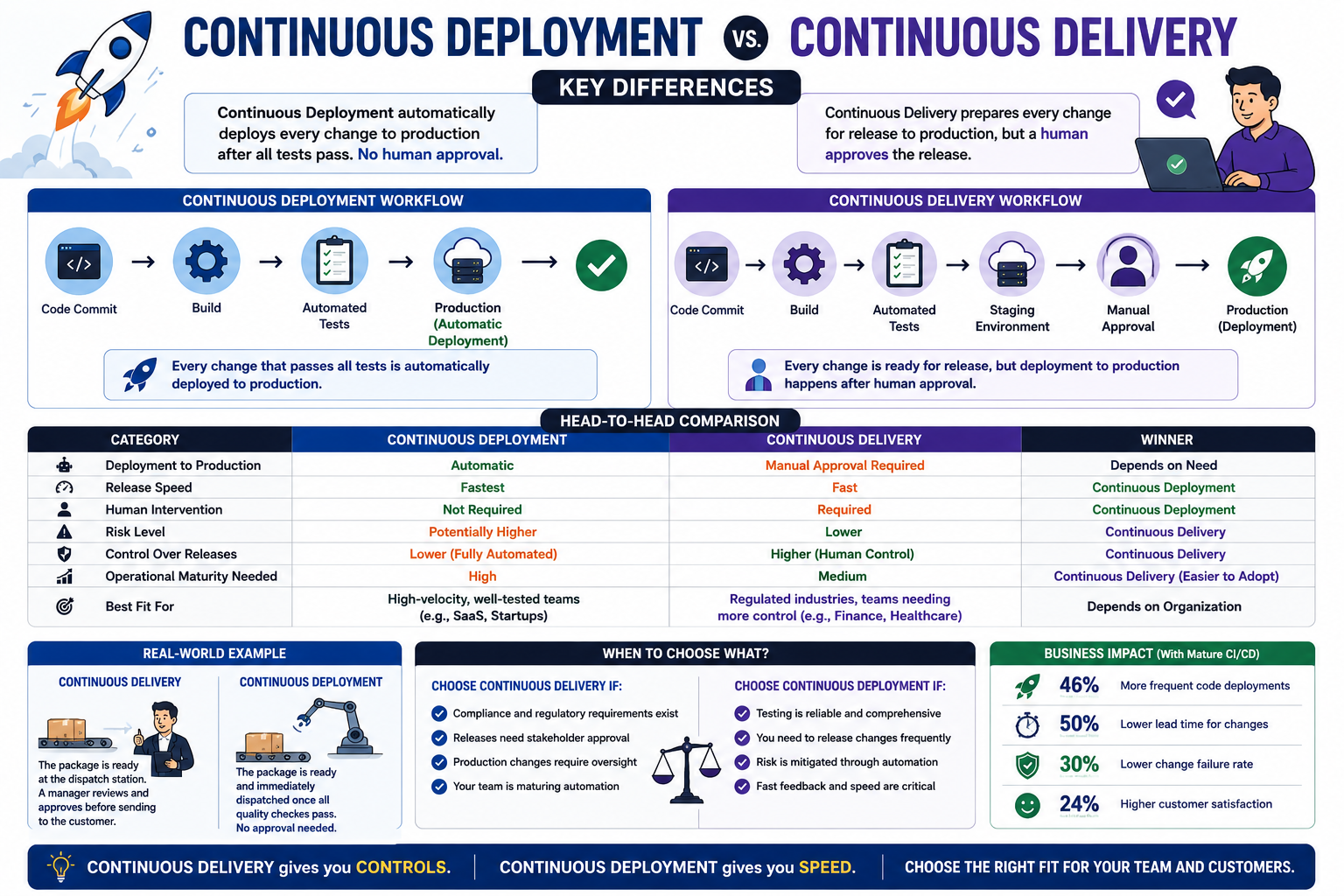
Continuous Deployment vs. Continuous Delivery: Key Differences
Many people use Continuous Deployment and Continuous Delivery interchangeably.
But while they are closely related, they are not the same thing.
Let’s break it down using a data-driven comparison.
The Shared Goal
Both Continuous Delivery and Continuous Deployment aim to: ✔ Automate software delivery ✔ Reduce manual work ✔ Increase release frequency ✔ Improve software quality
The difference lies in what happens after the application passes all tests.
Continuous Delivery
What It Means With Continuous Delivery, every code change is automatically: ✔ Built ✔ Tested ✔ Validated ✔ Prepared for release
However: A human still decides when to deploy to production.
Workflow
Code Commit ↓ Build ↓ Automated Tests ↓ Staging Environment ↓ Manual Approval ↓ Production
Key Advantage
Provides greater control over production releases.
Useful for:
Financial services Healthcare systems Highly regulated industries Continuous Deployment What It Means
With Continuous Deployment, every change that passes all tests is:
✔ Automatically deployed to production
No manual approval is required.
Workflow
Code Commit ↓ Build ↓ Automated Tests ↓ Production
Key Advantage
Delivers features to users as quickly as possible.
Common among:
SaaS companies Cloud-native startups High-velocity engineering teams
Real-World Example
Imagine an online food delivery company.
Continuous Delivery
The meal is prepared, packaged, and ready at the dispatch station.
A manager reviews it before sending it to the customer.
Continuous Deployment
The meal is prepared, packaged, and immediately dispatched once quality checks pass.
No manager approval is needed.
When to Choose Continuous Delivery
Choose Continuous Delivery if:
✔ Compliance requirements exist ✔ Business stakeholders approve releases ✔ Production changes require oversight ✔ Teams are still maturing their automation processes
When to Choose Continuous Deployment
Choose Continuous Deployment if:
✔ Testing is highly reliable ✔ Releases happen frequently ✔ Risk is well controlled through automation ✔ Fast customer feedback is a priority
The Business Impact Organizations with mature deployment automation often achieve:
✔ Faster release cycles ✔ Reduced lead time for changes ✔ More frequent deployments ✔ Improved customer responsiveness
The key is choosing the model that matches your organization’s risk tolerance and operational maturity.
The Bottom Line
Continuous Delivery means software is always ready to deploy.
Continuous Deployment means software is automatically deployed when it’s ready.
Think of it this way:
Continuous Delivery asks, “Should we release now?”
Continuous Deployment says, “The tests passed—let’s release now.”
Both improve software delivery.
The right choice depends on how much control versus speed your organization needs. 🚀