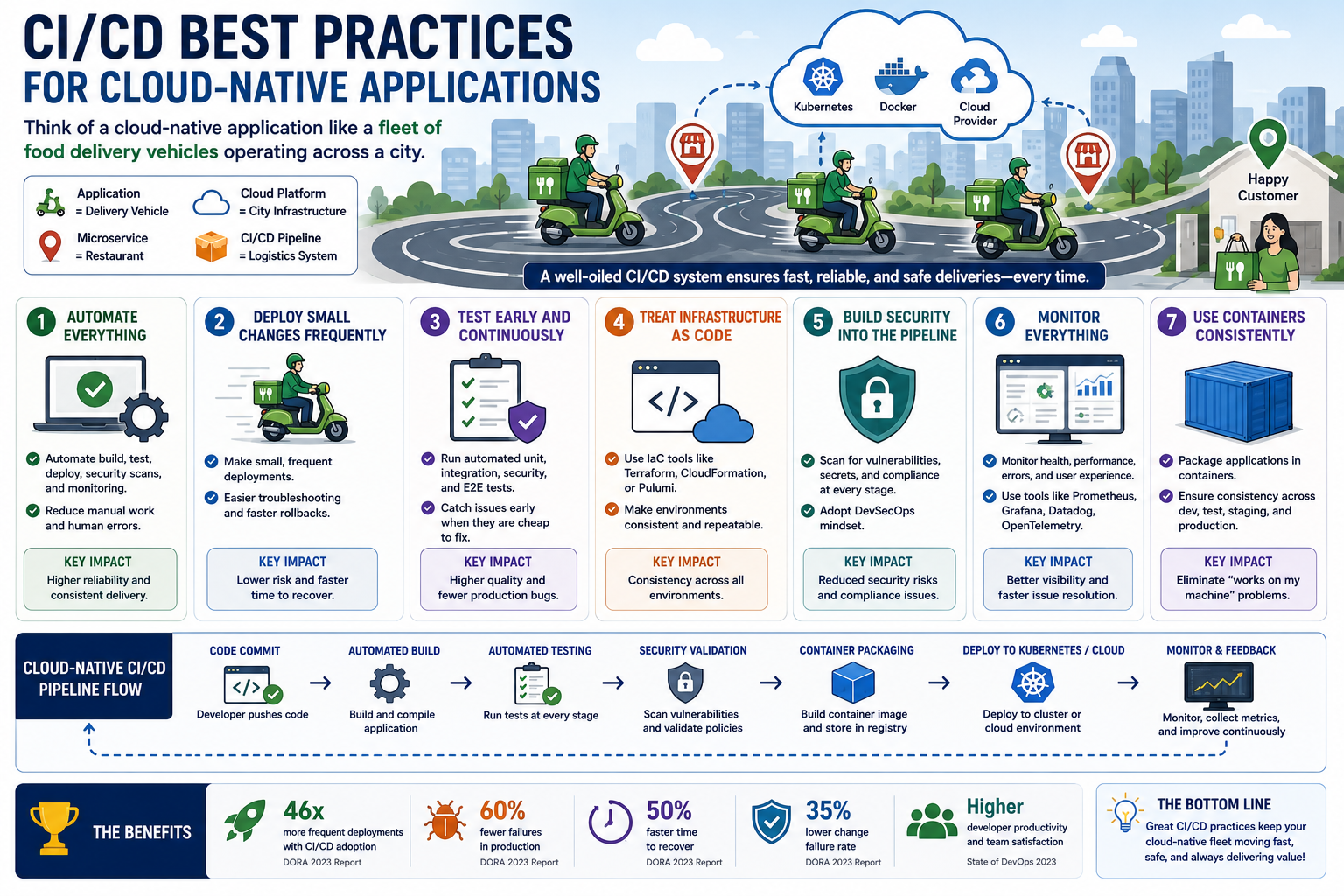
CI/CD Best Practices for Cloud-Native Applications
Cloud-native applications are designed for speed, scalability, and resilience.
But without the right CI/CD practices, even the most modern applications can become difficult to manage.
Here’s a simple way to understand it:
Think of a cloud-native application like a fleet of food delivery vehicles operating across an entire city.
To keep deliveries fast and reliable, you need more than drivers—you need a well-designed system.
1️⃣ Automate Everything Possible
Imagine asking drivers to manually plan every route, calculate every delivery, and update every customer.
Chaos would follow.
In cloud-native environments, automate:
✔ Builds ✔ Testing ✔ Deployments ✔ Security scans ✔ Monitoring
The less manual work involved, the more reliable the process becomes.
2️⃣ Deploy Small Changes Frequently
Large deliveries are harder to manage.
If something goes wrong, finding the problem takes longer.
Cloud-native teams perform smaller, more frequent deployments.
Benefits include:
✔ Easier troubleshooting ✔ Faster rollbacks ✔ Lower deployment risk
3️⃣ Test Early and Continuously
Would you wait until the end of the day to check whether delivery vehicles are working?
Probably not.
Cloud-native CI/CD pipelines automatically run:
✔ Unit tests ✔ Integration tests ✔ Security tests ✔ End-to-end tests
The earlier problems are detected, the cheaper they are to fix.
4️⃣ Treat Infrastructure as Code
Imagine rebuilding delivery routes manually every day.
Infrastructure as Code (IaC) allows teams to define environments using code.
Popular tools include:
✔ Terraform ✔ CloudFormation ✔ Pulumi
This improves consistency and repeatability.
5️⃣ Build Security into the Pipeline
Security should not be an afterthought.
Modern pipelines integrate:
✔ Dependency scanning ✔ Container image scanning ✔ Secret detection ✔ Compliance checks
This approach is often called DevSecOps.
6️⃣ Monitor Everything
Once deliveries begin, visibility matters.
Cloud-native teams continuously monitor:
✔ Application health ✔ Performance metrics ✔ Error rates ✔ User experience
Tools often include:
✔ Prometheus ✔ Grafana ✔ Datadog ✔ OpenTelemetry
7️⃣ Use Containers Consistently
Every delivery vehicle should operate the same way.
Containers help ensure applications behave consistently across:
✔ Development ✔ Testing ✔ Staging ✔ Production
This reduces the classic “works on my machine” problem.
Why These Practices Matter
Organizations that adopt mature CI/CD practices often achieve:
✔ Faster release cycles ✔ Higher deployment success rates ✔ Reduced downtime ✔ Better scalability ✔ Improved customer experience
Cloud-Native CI/CD Flow
Developer Pushes Code ↓ Automated Build ↓ Automated Testing ↓ Security Validation ↓ Container Packaging ↓ Deployment to Kubernetes/Cloud ↓ Monitoring & Feedback
The Bottom Line
Cloud-native applications are built to move fast.
CI/CD best practices ensure they can move fast without sacrificing quality, reliability, or security.
Because in cloud-native development, success isn’t just about deploying more often.
It’s about deploying safely, consistently, and confidently. 🚀