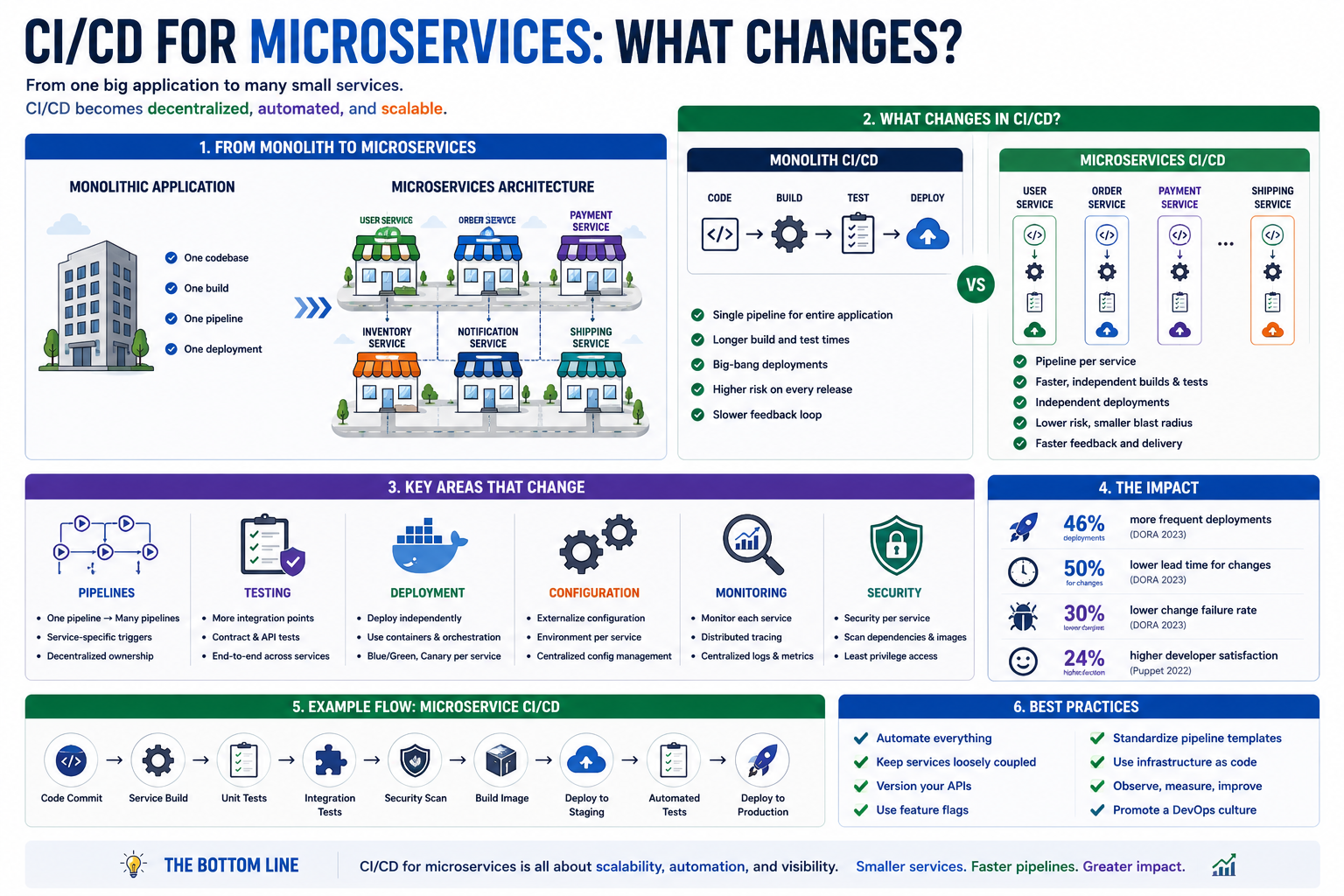
🚀 CI/CD for Microservices: What Changes? Part 2
🌐 5️⃣ Communication Matters More
Independent stores still depend on roads and traffic signals.
Microservices communicate through APIs.
Your pipeline should verify:
✔️ Service compatibility
✔️ API contracts
✔️ Version compatibility
One broken API can affect multiple services.
📦 6️⃣ Containers Become Essential
Imagine every store using different delivery trucks.
Operations would become chaotic.
Containers provide consistency.
🚢 Docker packages every service the same way.
☸️ Kubernetes deploys and manages them at scale.
Consistency reduces surprises in production.
📊 7️⃣ Monitoring Is No Longer Optional
If one shop experiences problems, customers shouldn’t blame the entire city.
Microservices require deep visibility.
Monitor:
📈 Individual services
📈 API performance
📈 Error rates
📈 Latency
📈 Resource utilization
Finding problems quickly is just as important as deploying quickly.
🌟 Why Microservices Need Smarter CI/CD
Modern pipelines help teams achieve:
⚡ Faster deployments
🔄 Independent releases
🛡️ Better resilience
📉 Reduced downtime
🚀 Greater scalability
😊 Faster customer feedback
🎯 The Bottom Line
CI/CD doesn’t fundamentally change with microservices; its scope does.
Instead of managing one large application, you’re coordinating dozens or even hundreds of independent services that must work together seamlessly.
Just like running a thriving city requires organized roads, utilities, and logistics, managing microservices requires automated, scalable, and intelligent CI/CD pipelines.
Because in cloud-native development…
🚀 The goal isn’t just to deploy faster; it’s to deploy every service independently, reliably, and confidently.
💬 What’s been your biggest challenge when building CI/CD pipelines for microservices?
Share your experience below! 👇