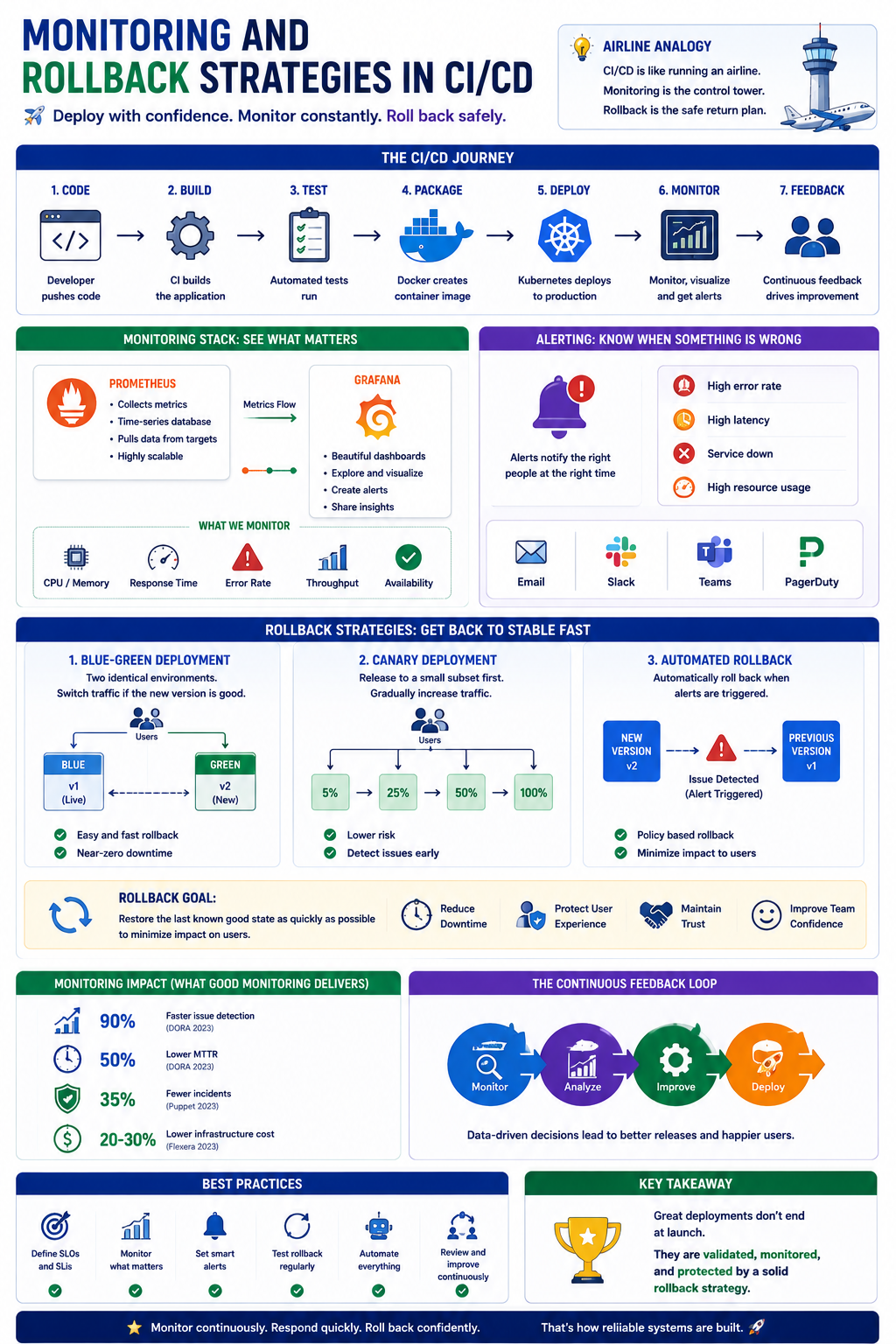
📊 Monitoring and Rollback Strategies in CI/CD Part 2
🔄 5️⃣ Rollback Is the Emergency Return Plan
Now imagine an aircraft develops a serious technical problem shortly after takeoff. The pilot doesn’t continue simply because the flight already departed.
There must be a safe way back. That’s what a rollback strategy provides.
If a deployment introduces serious problems, teams can return the application to a previously known-good version.
Instead of spending hours repairing production while customers are affected:
🚨 Problem detected
⬇️
🔄 Rollback initiated
⬇️
✅ Previous stable version restored
🟦🟩 6️⃣ Blue-Green Deployment Reduces Rollback Risk
Imagine an airline preparing a replacement aircraft before taking the existing one out of service. That’s similar to blue-green deployment.
You maintain two environments:
🔵 Blue — Current production version
🟢 Green — New version
Traffic moves to Green after validation. If something goes wrong?
↩️ Traffic can be redirected back to Blue.
This makes recovery much faster than rebuilding the previous environment from scratch.
🐤 7️⃣ Canary Releases Limit the Blast Radius
Airlines don’t always introduce major operational changes across their entire fleet at once. They may test them with a smaller group first. A canary deployment follows the same principle.
Instead of sending 100% of users to the new release:
➡️ Start with 5%
📊 Monitor the results
➡️ Increase to 25%
📊 Monitor again
➡️ Gradually move toward 100%
If problems appear early, only a small percentage of users are affected.
🎯 Small exposure. Fast feedback. Lower risk.
🔁 8️⃣ Monitoring Completes the CI/CD Feedback Loop
A CI/CD pipeline shouldn’t end with:
Build → Test → Deploy
A mature pipeline looks more like:
👨💻 Code
➡️ ⚙️ Build
➡️ 🧪 Test
➡️ 🚀 Deploy
➡️ 📡 Monitor
➡️ 📊 Analyze
➡️ 🔄 Rollback or Improve
➡️ 👨💻 Feed insights back into development
Monitoring tells you whether the release is actually working in the real world.
🚀 Why Monitoring and Rollback Matter
Together, they help teams achieve:
⚡ Faster incident detection
🛡️ Lower deployment risk
🔄 Faster recovery
📉 Reduced downtime
📊 Better production visibility
😊 More reliable customer experiences
🎯 The Bottom Line
Deploying software without monitoring is like flying an aircraft without radar.
Deploying without a rollback strategy is like flying without an emergency plan.
A strong CI/CD process doesn’t simply ask:
🚀 “Did the deployment succeed?”
It also asks:
📊 “Is the application healthy?”
👥 “Are users experiencing problems?”
🔄 “Can we recover quickly if something goes wrong?”
Because in modern DevOps, the goal isn’t simply to deploy faster.
It’s to deploy confidently, observe continuously, and recover quickly. 🚀