
☁️ CI/CD Best Practices for Cloud-Native Applications
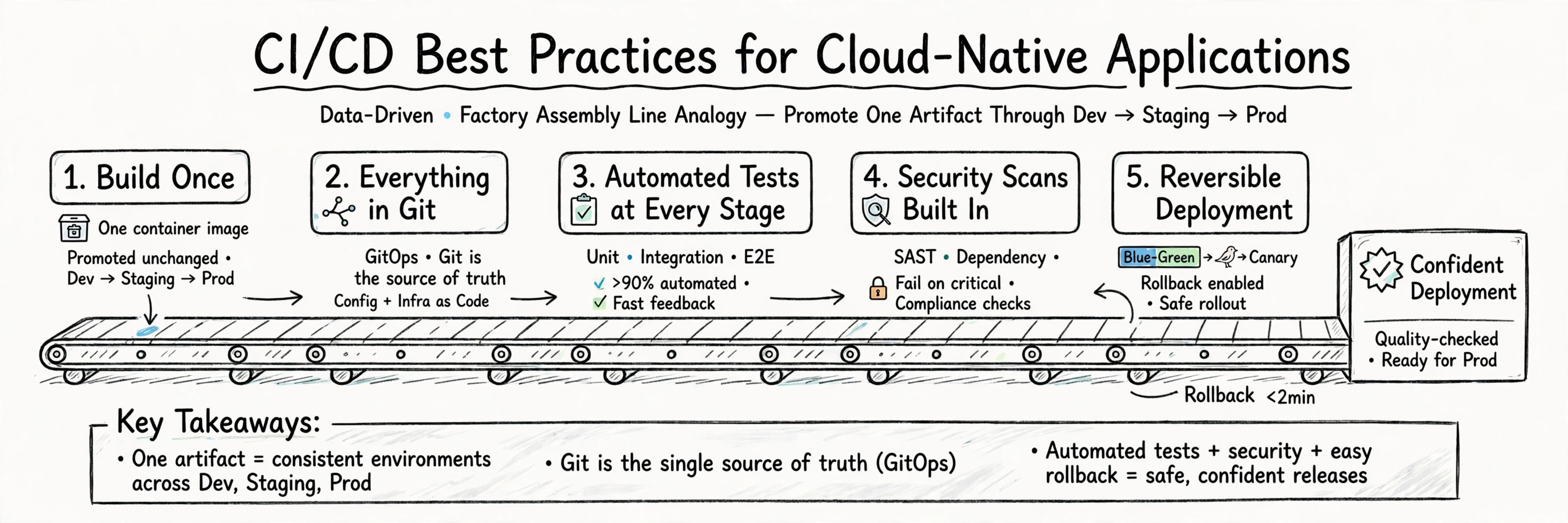
Cloud-native applications are built to change fast: small services, containers, and frequent releases.
But speed without discipline creates a different problem: deployments that are hard to repeat, hard to roll back, and hard to trust.
Here is a simple way to think about it:
🏗️ Think of your pipeline like a factory assembly line.
Every build should follow the same steps, in the same order, every time.
If the line changes depending on who runs it, you do not have a pipeline. You have a habit.
1️⃣ Build Once, Deploy Everywhere
Build your container image once, then promote that same image through development, staging, and production.
❌ Do not rebuild the image for each environment.
✅ Do tag the same image, for example myapp:1.2.3, and deploy it everywhere.
If you rebuild it, you are no longer testing what you will ship.
2️⃣ Keep Everything Declarative
Your infrastructure, your Kubernetes manifests, and your pipeline steps should live in Git.
That is GitOps in practice:
👨💻 Change the code or config
⬇️
📝 Open a pull request
⬇️
✅ Review and merge
⬇️
🚀 The cluster is updated to match Git
Git becomes the source of truth, not a manual change someone made on a Friday afternoon.
3️⃣ Ship Small, Ship Often
Big releases are big risks.
Smaller, more frequent deployments are easier to test, easier to review, and easier to roll back when something goes wrong.
🎯 Aim for small changes that do one thing well, instead of one giant release that does everything at once.
4️⃣ Automate Tests at Every Stage
A pipeline without tests is just a fast way to ship bugs.
Run the right checks at the right stage:
🧪 Unit tests on every commit
🔗 Integration tests before staging
🔒 Security scans before production
👀 A smoke test after every deployment
If a test fails, the pipeline should stop. That is the point.
5️⃣ Keep Environments as Close as Possible
Development, staging, and production should behave the same way.
Use the same base images, the same configuration patterns, and the same deployment steps.
💡 The classic failure is: “It worked on my machine.”
In cloud-native work, the fix is: make every environment look like production, as early as possible.
6️⃣ Make Every Deployment Reversible
Every deployment should have a way back.
That can be:
🔄 Rolling back to the previous image
🚦 A blue-green deployment
🐤 A canary release to a small group of users first
If you cannot roll back quickly, you are not ready to deploy quickly.
7️⃣ Build Security Into the Pipeline
Security is not a step you add at the end.
✅ Scan container images for known vulnerabilities
✅ Store secrets outside your code. See the Secrets in CI/CD series.
✅ Give the pipeline only the permissions it needs
✅ Keep credentials short-lived where possible
A fast pipeline that leaks secrets is not a good pipeline.
✅ CI/CD Checklist for Cloud-Native Applications
Before you call your pipeline ready, ask:
✅ Is the same image built once and promoted everywhere?
✅ Is your infrastructure and config stored in Git?
✅ Are changes small and deployed often?
✅ Do automated tests run at every stage?
✅ Are environments consistent from dev to production?
✅ Can you roll back quickly?
✅ Is security scanned in the pipeline, not after it?
🎯 The Bottom Line
Cloud-native CI/CD is not about deploying faster for its own sake.
It is about deploying with confidence:
🏗️ The same build, every time
📝 The same process, in Git
🧪 Tests that stop bad changes
🔄 A way back when things go wrong
Because in DevOps…
🚀 Automate the deployment, and make the result repeatable, testable, and reversible.
💬 Which of these practices made the biggest difference on your team: smaller releases, GitOps, or better automated tests? 👇
#DevOps #CloudNative #CICD #Kubernetes #Docker #GitOps #SRE #CloudComputing #DevSecOps