🚀 Continuous Deployment vs. Continuous Delivery: Key Differences
Continuous Delivery and Continuous Deployment sound almost identical. Many teams use the two terms interchangeably.
They are not the same thing. The difference is one word, and that one word changes who decides when your code reaches real users.
Here is a simple way to think about it, using the factory from this article:
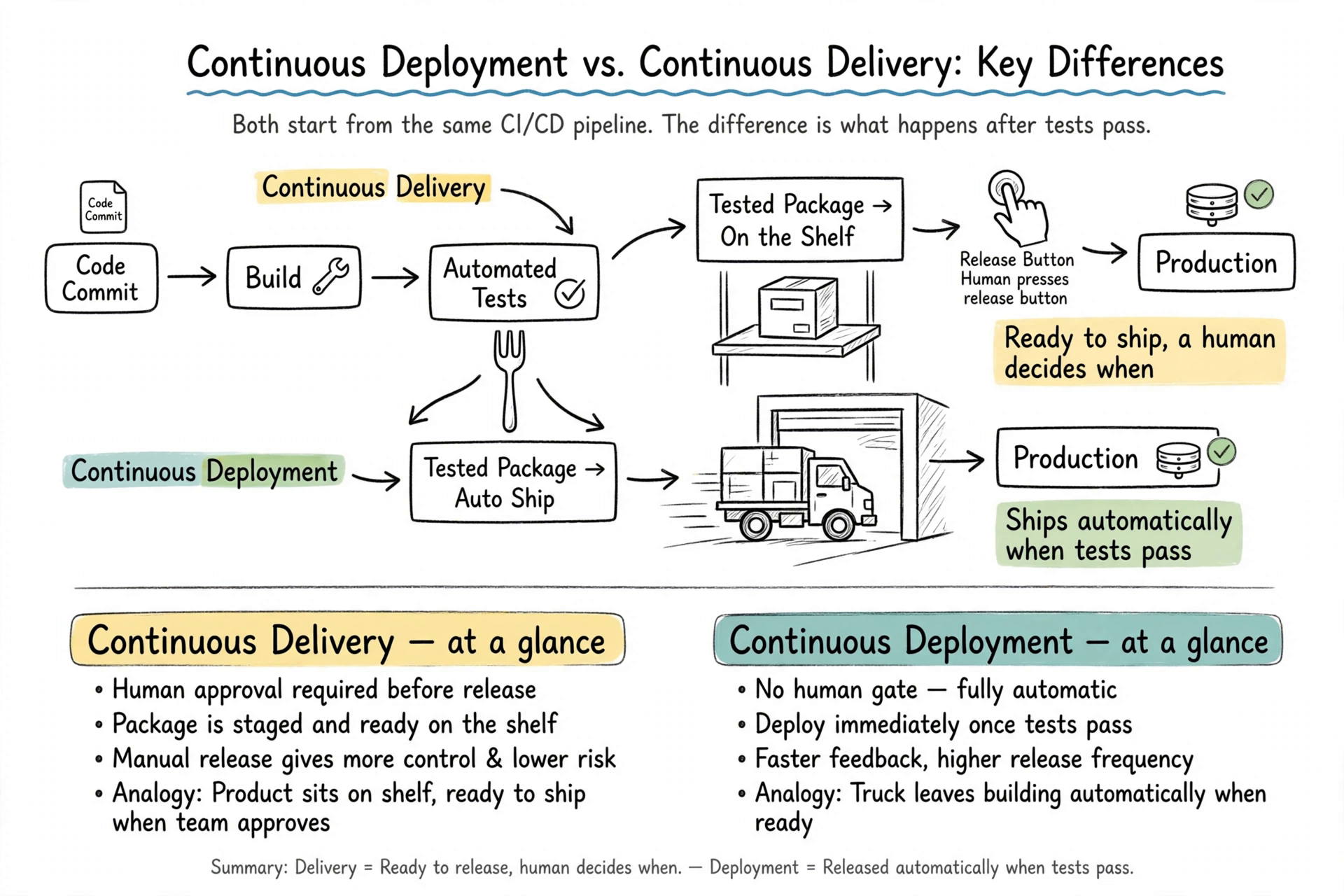
🏭 Delivery means the product is boxed and ready on the shelf. Deployment means the truck has left the building.
Both need a good factory. Only one of them ships without anyone pressing a button.
1️⃣ What Continuous Delivery Means
In Continuous Delivery, every change that passes your tests is ready to release to production at any time.
The code is built, tested, and packaged. The release is ready. A human still makes the final call on when it goes out.
That final call is usually a business decision, not a technical one. Maybe you want to wait for a launch window, a marketing announcement, or a quieter time of day.
Delivery answers this question: “Could we ship right now if we wanted to?”
If the answer is yes, every time, you have Continuous Delivery.
2️⃣ What Continuous Deployment Means
In Continuous Deployment, every change that passes your tests goes to production automatically. There is no manual release step and no deploy button to press.
A developer merges a change, the pipeline runs, the tests pass, and users get the new version. No one has to approve that specific release, because the pipeline itself is the approval.
Deployment answers a different question: “Did it ship already?”
If the answer is yes, automatically, you have Continuous Deployment.
📊 The Two Side by Side
| Continuous Delivery | Continuous Deployment | |
|---|---|---|
| Who decides to ship | A person, at a chosen time | The pipeline, automatically |
| When code reaches users | When the team chooses | As soon as tests pass |
| Manual step | Yes, one final approval | No, fully automated |
| Speed | Fast, on your schedule | Fastest, on every merge |
| Risk if tests are weak | A bad release waits for a human to catch it | A bad release ships on its own |
3️⃣ The Key Differences, in Plain Terms
Who holds the button. Delivery keeps a human in the loop for the final release. Deployment hands that decision to the pipeline.
When users see the change. With delivery, a change can sit ready for hours or days before it ships. With deployment, it ships in minutes.
How much you must trust your tests. Deployment only works when your automated tests are strong enough to be the gatekeeper. If a bug can slip past your tests, deployment will ship that bug just as fast as it ships a fix. Delivery gives you a human safety net. Deployment does not.
How rollbacks work. Both need a fast way back, as described in this article. With deployment, rollbacks happen more often, because releases happen more often, so the rollback path has to be automatic too.
What the team feels. Delivery feels controlled. Deployment feels fast. Both are good feelings, but only if the team trusts the pipeline behind them.
4️⃣ They Are Not Rivals
Continuous Deployment is not a replacement for Continuous Delivery. It is built on top of it.
You cannot do deployment well until you can do delivery well. If every change is not reliably releasable, automating the release only automates the mess.
Think of it as a ladder:
🥾 Step 1: Automate your builds and tests.
📦 Step 2: Reach Continuous Delivery, where every change is ready to ship.
🚀 Step 3: Add Continuous Deployment, where ready changes ship on their own.
Skipping step 2 is how teams end up shipping broken code at machine speed.
5️⃣ Which One Should Your Team Choose?
Ask these three questions:
🎯 How confident are you in your tests? If the honest answer is “not very,” start with delivery and strengthen the tests first.
⏰ How often do you need to ship? A team that ships once a week may be happy with delivery. A team that ships many times a day usually needs deployment.
🛡️ How fast can you roll back? If a rollback takes an hour of manual work, deployment will hurt. If it takes one click, or happens automatically, deployment is safe to try.
There is no wrong answer here. Many strong teams stay on Continuous Delivery on purpose, because they want a human to choose the release moment. Others move to Continuous Deployment because their tests and monitoring earn that trust.
The mistake is not choosing one or the other. The mistake is claiming you do one while actually doing neither: changes that are not tested, not releasable, and shipped by hand on a Friday afternoon.
✅ Delivery vs. Deployment Checklist
Before you call your pipeline ready, ask:
✅ Is every change that passes tests ready to release?
✅ Is the release decision a clear, deliberate step, or an accident?
✅ Are your tests strong enough to be the only gatekeeper?
✅ Can you roll back quickly, without manual heroics?
✅ Does the whole team know which model you use, and why?
🎯 The Bottom Line
Continuous Delivery means you can ship at any time.
Continuous Deployment means you do ship, every time the tests pass.
🏭 Delivery is the boxed product on the shelf.
🚚 Deployment is the truck leaving the building.
🧪 And neither one works without the discipline from this article: build once, test at every stage, and always keep a way back.
💬 Which model does your team use today, delivery or deployment, and what would it take to earn the trust to move to the next step? 👇
#DevOps #CICD #ContinuousDelivery #ContinuousDeployment #CloudNative #DevOps #GitOps #SRE #CloudComputing